
Lesson 3 (Part 2: Expectations to Symptoms)
We will start with a new picture today. We will talk about expectation, and we will draw a picture of how expectation works.
So, let's take a sheet of paper and at the top of the page write "Expectations". Then across from there on the right side, let's put "based on the what ideal."
*Now we remember that the ideal is to regain the non-disturbed state by gaining pleasure and escaping pain on all levels. We want pleasure of physical comforts, physical sensations; and we want the sensation of favorable attention. We want the pleasure of feeling important and being able to control other people.
*We want to regain the non-disturbed state by escaping physical pain. We want to avoid being ignored or rejected. We want to avoid disapproval. And we want to avoid the sense of feeling inferior because things don't happen like I want them too. People just don't do what I want them to.
Now we have an expectation based on the ideal--the first decision, the one that is dark drawn over in the "picture of man" as he is in his "conditioned" state.
Everything we do is based on an expectation. We don't start to do anything unless we felt it was "true" and "valuable". We expect that it will work out the way we see it. And what is valuable to us in the "conditioned" state is to be non-disturbed. What is "true" to us is that this action will bring "it" about. It could be any of the six decisions of the four dual basic urges, or maybe something else in the everyday affairs.
We wouldn't put a key in a lock unless we expected it to unlock. We wouldn't put the mix of a bunch of different ingredients in a pan to cook it unless we expected that it would cook and somebody would eat and enjoy it.
We also expect that every thought we have of gratification will be fulfilled. We expect that if we "complain", that everybody will get with it and do what we want them too.
We expect that if we "stick up for our rights" that everybody will see our rights and do them.
It doesn't usually happen this way and we're usually unconscious of the expectation.
So let's make the expectations conscious. We will write down "our" expectations on the sheet of paper. Across from that we'll write what "ideal" (ought to be) we had. We can then discover how many of the expectations are based on the basic idea that the whole purpose of living is to be "non-disturbed."
We will notice that in interpersonal relationships, one is disappointed because one had the expectation that everybody is "fully conscious." We'll find that we believe that they know what is right, proper and justifiable; but they go on and do wrong anyway. [anti-agape-see excerpt page for more information]
We will find we expect that they all know what I want and what is "good" and what I put "value" on and that they will act accordingly. In this, we will find many; disappointments.
So we will put on our paper, or on a separate sheet a list of "my disappointments". We'll write down all the times I was disappointed this week and in the weeks to come. Then we will be able to observe them. We'll see what "ideal" I had in mind.
Perhaps the "ideal" is someone should remember my birthday. But they had other things to do, and they forgot. We decide that they deliberately ignored me. This being ignored and rejected is a pain.
When one is disappointed, one feels hurt, or ignored, or rejected, or disapproved of. This leads to looking for blame when we are "conditioned." So, on our sheet of paper we will have an additional heading of
"What or who I blame for my disappointment and hurt.
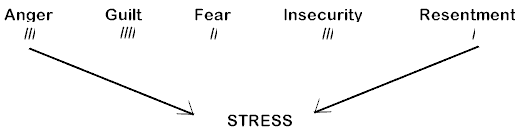
We will find that this is where we experience the anger, guilt, fear and insecurity. On our sheet or sheets of paper, we can now put headings of those four emotions and their counterparts of resentment, jealousy, inferiority and any others you discover. Under those we'll put marks and when we get four of them, make a cross mark through them for the fifth one.
So we started with expectations based on an ideal, which leads to disappointment, which leads to hurt, which leads to looking for blame, which leads to an unpleasant emotion.
This is a little diagram of the inner working of the "self," and of the "conditioned" awareness. We want to be aware of it's function and how it's working. We're not trying to change it, we're just getting acquainted with it.
Emotions
Guilt - regret, I wish I hadn't done that
Fear - something is not right to us, but we don't know what to blame it on
Worry - this may happen, but I don't know
Insecurity - inability to control the situation
Under those emotions and slash marks, draw an two arrows pointing down and write the word "STRESS."
Stress is what the body [motor function] reacts to. The body reacts to a burn or fall; but we're interested in the inner stresses. The stress that originates from the inner state of being; in other words the expectation of the ideal not being realized.
The body goes into a state of chemical imbalance and neuromuscular tension.
Whenever we are angry, guilty, fearful or feel very insecure, we're telling X that we are in an emergency; and X sends the message down to the motor function to charge the body with tremendous energy to FIGHT or RUN. (The charge comes from the use of various hormones from the ductless glands. These are adrenaline, thyroxin, pituitary extract and a big charge of glycogen from the liver)
One is all charged up for the state of emergency (a violent physical challenge), but we only had our feelings hurt because we didn't realize the ideal; and thereby, the non-disturbance.
Now we have chemical imbalance and neuromuscular tension. It has gone from the psychological to the physiological; and this requires what we call "ADAPTATION". We cannot live with the body being all charged up to fight or run. But no fighting or running is taking place. Now X begins an "adaptation" to restore the body to the chemical balance for the actual time, place, and circumstance.
You may be sitting in a warm room on a soft sofa with no physical violence anywhere in sight; but inside is a "seething turmoil". Sometimes there is an accumulation of it.
So then, this ADAPTATION takes one of two forms:
1. The most usual one is UNUSUAL CELLULAR ACTIVITY. A group of cells begin to do something they ordinarily don't do in order to use up the mobilized and unreleased energy from the chemical imbalance and neuromuscular tension from the sense of being angry, guilty, fearful, resentful (being in a state of emergency.)
Unusual cellular activity is known as a change in function. So some aspect of the body begins to function differently. It always results in a change in sensation from the usual and is experienced as physical pain, fullness, stiffness, soreness, or aching.
Then, of course THAT becomes an emergency because "I was disappointed"; and now I am suddenly feeling rough. I feel hurting all over, uncomfortable physically; and I begin to look for what's the cause of the physical discomfort. (Cause really means blame, does it not?)
So, what's to blame for this sensation, and this change in function. It must be the flu, or it might be cancer, or it may be aids--no telling what it is. It's got to be something bad.
It is frightening, so there is more charge of energy and that, again, must be ADAPTED to. So more cells are drawn into the process of restoring the body to balance. If this keeps on long enough, finally these tissue cells that are involved in the unusual cellular activity begin to break down or they are altered in some form or other. A good example is a callous on the hand due to stress from friction. As long as that friction is there, there's going to be a change in tissue. If you ever quit the friction, the callous goes away in a little while.
So one has a physical disability, a physical adaptation. It's REALLY a perfectly normal adaptation to some stress. It is X's way of restoring the body to health. If one understands it and doesn't get excited about it, it's over very quickly.
If one gets excited about it, doesn't understand it, it becomes on and on chronic because there is a continual cycle of being concerned about the symptom. Fear builds up more chemical imbalance and neuromuscular tension and requires more adaptation of unusual cellular activity, unusual sensation and tissue cell alteration and a breakdown.
So one might say that "having an expectation based on the ideal" (which is an illusion) is the DISINTEGRATING FACTOR IN MAN.
The other way of adapting is UNUSUAL BEHAVIOR.
2. One goes on a binge. One gets drunk or thows a wild temper tantrum. In extreme cases, people go on robbing binges. They go on drug binges and etc.
Now for a very practical something to do:
Write down when one has the anger, guilt, fear or insecurity along with the date and time. Then observe what happens within 72 hours.
Usually the adaptation doesn't follow immediately. If it did, we would have all caught on a long time ago. We have already calmed down from the emotional spells. We don't get the symptom because it takes X a little time to notice that the body is in a state of chemical imbalance; and to see if you're going to do something (fight or run) and use it up.
If you don't, then X has to adapt to the imbalance. The symptoms occur from 12 to 24 to 32 to 36 to 48 hours following the time the emotions occurred.
So we will keep a record; and we'll begin to understand symptoms. What symptom did I have between 1-72 hours after all these marks. You can begin to realize that all symptoms are normal adaptations. It is X's way of restoring the body to health, to chemical balance, to natural tone. It relieves stress.
If one sees this process and understands the purpose with a feeling of thankfulness, one will find that the symptoms are all gone very quickly.
Keep records and you will understand and cease to be alarmed at symptoms. You will be thankful for them because you see they are the expression of a loving spirit to restore it's body to normal, usual creative functioning. All you are really aware of is that the body is a great, valuable, and beautiful instrument.
[From Dr. Bob's description on Tape 3 from the Teachings, I think the written sheets might look something like this.]
1. My expectation_____________________________________Ideal___________________________
(the ideal is an illusion)
(Just for reminders) the 4 dual basic urges
Gaining
Physical comfort
Favorable attention
Favorable approval
Feeling important
Controlling other people
Escaping
Physical pain
Being ignored or rejected
Being disapproved of or embarrassed
Feeling inferior
2. My disappointments_______________________________
3. What or who I blame______________________________
4. Unpleasant emotion experienced:
(after the charge of energy to fight or run which wasn't used)
Adaptation occurred in what time frame________________________________________
X used unused energy to restore the body to chemical balance by:
Unusual cellular Activity or Unusual Behavior
YOU CAN GO HERE FOR Lesson 3 (Part 1: Completing the Picture of Man)
BELOW IS A VERBATIM TRANSCRIPTION OF THE ENTIRE LESSON 3:
As we have been doing the Work for the past two weeks, we’re probably by now beginning to notice that there is various and sundry thoughts racing through the mind that says things like, “There isn’t anything worthwhile in this – drop the whole thing.” Some self-improving “I” comes along and says, “You’re really a mess. “I’m” a mess. This is terrible! “I” don’t want to find out these things about “me”!” and that really one should do a great amount of suddenly changing the whole thing. Or another one says, “What’s the use? This doesn’t change anything. It’s just making it worse.” Now all of these are very natural occurrences and they happen to everyone who takes up the study of self and to have Self-Knowing. All these doubts and et cetera will come along because one begins to discover certain things that are not exactly pleasing and not in keeping with vanity, especially as we write them down and looked at them. But this is essential and it is necessary.
And it is first thing – is to be knowing self as to what happens. And we will be working on knowing self, that the self may undergo a transformation. But if one doesn’t know the self, there is no hope of a transformation. One may hide the self, may keep it undercover and be blind to it; but it still destroys. So to bring it to Awareness, to be conscious of it, to pay attention to it – while it may not be very, very pleasant at this moment, it definitely has a great value. So, let’s continue our work.
Completing the Picture of Conditioned Man
Now we’ll start this week with completing the picture we started on last week of the Picture of Man as we find him in his conditioned state. We had the basic idea that the whole purpose of living was to be non-disturbed and we had four ideas of improving the self in order to actualize this non-disturbed state. The first one of course was [1] complain, which didn’t work and hasn’t worked so far. The second one was [2] sticking up for rights, which hasn’t worked so well. Trying to [3] please people – it sometimes does, but it creates quite an inner havoc. And then we looked at the one that [4] one must believe and do as one is taught by one’s authorities, whether it’s in newspapers, books, television, what someone says, or by some authority figure that we might run into in our affairs. And we’ve been writing down how we practiced each of these.
Now, the next decision that the infant makes is that [5] “It’s important to be different”. In other words the way I’ve been gettin’ along up to this date has been quite a conflict. So, “I” should be different. So here comes the effort to put on a front. “It is the thing to be, to do, so that people will approve of “me” and give “me” attention… and that “I” will look good, and that “I” can approve of self.” But it’s all on the outside. It is not due to an inner state of really discovering that there is a way to behave, a thing to do; but it is to put on a front of impressing people. This has been referred to as the Scribe and the Pharisee, the one that put on the front.
Now we, by trying to appear to be different, build quite barriers over these four we looked at for the past few days. And we’re usually unaware of ‘em. However, they work but we give them other names. We don’t describe them as we have very bluntly in these pictures that we’re building now. So we have on the “B” side above the one that says “Please Everybody”, is that “It Is Important To Be Different”. And so this is, of course, different behavior. And the person is trying. But ever’ so often one of the others reacts and one has an explosion of temper or one has an explosion of resentment or one has a fit of jealousy, or whatever. But they will continue to appear; and then, of course we only give those others names and we try to describe them different, as well as appearing to be different. But this doesn’t bring any peace to the person’s being.
And the child probably is seven or eight years old by now and so he makes another decision. Maybe he makes it earlier than this, or a little later – the time element is relatively unimportant because we’re talking about the person with all of ‘em now, anyway. Over on the “A” side he comes up with another very solid decision, which we will put opposite the one that “It’s Important To Appear To Be Different.” And this one, he has discovered that it’s really everybody else’s fault that he wasn’t always different. So he says that its whole worthwhile thing here is to establish what is to blame. So, we will just simply put [6] “Blaming” here.
Now, when a person blames somebody, he always tries to get them to straighten out so that they will do what they ought to do. And then of course everything would be fine for “me” and “I” could go on in the illusion that “I’m” quite different. Because there would be nothing to upset the appearing to be different by putting on this particular mask or behaving differently. There would be no challenges if everybody else would just be different. So, we build quite solid accounts against everybody that we come up with to blame.
Now this is a very fundamental School idea: that we build accounts. In other words, we’ve established a blame and we say that person owes “me” an apology, or they owe “me” damages, or they owe “me” to behave differently. And this, the School idea says, is the burden that every human carries. It is what ages a person. It is what gradually disintegrates the person over a period of time. One big aspect of it is the Accounts Receivable we have against all people. It is blaming and that they should do different. So the infant decides that, “If everybody else were just different, then “I” would be just as peaceful and pleased and happy as “I” could be. But they’re not different, so they’re to blame and theydo owe “me”.”
So we have now six basic ideas of self-improvement and the big ideal. So we have a Picture of Man, each of us, as we are in everyday life until we have studied ourselves and observed what goes on for a considerable length of time. Now, this time is not indefinite. We’ll be doing it in a very reasonable number of months or weeks, but it’s not going to be gone tonight. But we do want to be aware of it. We want to be conscious that this is going on.
So we will add two more sheets of paper to observe now. Another page in the book is that “ “I” Ought To Be Different.” So, every time one notices that one should have been different or ought to be different, or one is putting on a particular front, or is fancyin’ up the story a little bit, one writes it down – again not for other people, but for one’s personal use.
And on the other side we will put “All The People We Blame” and “What They Would Have To Do In Order To Pay The Debt.” Now someone has no doubt apologized to you many times. Did that end the hurt or are you still nursin’ it a little bit? Recall the incident and see what kind of a feeling arises within you. Someone cheated you and then they apologized. Or they forgot your birthday. Or they forgot the anniversary. Or promised to take you to a certain party and they forgot all about it and didn’t get home for all hours later. And they apologized and said how sorry they were. But let’s recall those incidents and see if there is still a decided feeling, “They owe “me”, they mistreated “me”,” – a hurt feeling, if you please.
Now we have six sheets of paper as to which we’re keeping up with. We won’t see all the incidents but we can certainly add a little bit to it each day. And each bit we add is knowing a lot about this conditioning that is controlling one’s existence and (if we may say, is destroying that existence.) First, it is in conflict, is it not? “A” is against “B” and “B” is against “A”. The real person with a will is not even there. That is a myth we read about up to this point. Maybe someday we will have a will and we can…maybe all the conditioning can be gone. But at this moment we are only interested in knowing about the conditioning and watch it work. Because without being aware of this conditioning and how it works we wouldn’t even believe it’s there. It usually comes as quite a shock to any of us to discover what is really within. It is as though we had a lovely home and we suddenly found it was infested, almost to the point of destruction, by termites. We’d be quite shocked. But if we never did find about the termites, we wouldn’t do anything about it until the house fell in and then it would be too late. So while we might see all these things of conditioning as termites and they are slowly, but surely, sapping the strength of one’s being. So we have ever’ reason to observe them.
From Expectations Based on the Ideal…
Now we will start with us a new picture today. We will talk about expectation and we will draw a picture of how expectation works. So, let’s take a sheet of paper and on the long side of it draw a straight line. And let’s write under that line: “Expectations Based On The Ideal.” Now we will remember that the ideal is to regain the non-disturbed state by gaining pleasure and escaping pain on all levels. We want pleasure of physical comforts, physical sensations, and we want the pleasure of having favorable attention and we want the pleasure of having approval. And we want the pleasure of feeling important, being able to control other people. We want to avoid physical pain. We want to avoid being ignored or rejected. And we want to avoid disapproval. And we want to avoid the sense of being inferior because things don’t happen like “I” want them to. (People just don’t do what “I” want them to.) So now we have expectations based on the ideal – the first decision, the one that’s dark, drawn over in the Picture of Man as he is in his conditioned state.
Now, everything that we do is based on an expectation. You don’t start to do anything unless you felt it was true and valuable; so therefore, it is an expectation that it will work out the way we see it. And of course, what is valuable to us in the conditioned state is to be non-disturbed. And what is true is that this action will bring it about, whether it be any one of those six or maybe somethin’ else in the everyday affairs. We wouldn’t put a key in a lock unless we expected it to unlock. We would not go out and get in the car unless we expected the car to start and to travel. We wouldn’t put the mix of a bunch of different ingredients in a pan to cook it unless we expected that it would cook and we expected somebody to eat it and to enjoy it, and et cetera. We also expect that every thought we have of gratification will be fulfilled. We expect that if we complain, that everybody will get with it and do what we want them to. We expect if we stick up for our rights that everybody will see our rights and do them. However, it doesn’t usually happen this way and we’re usually unconscious of the expectation.
So, let’s make the expectations conscious. We will write down a sheet of paper that says, “These Are “My” Expectations and They Are Based On:” and we will see how many of ‘em is on this basic idea that the whole purpose of living is to be non-disturbed. Now, there will be others of course based on the actual events of everyday existence that’s not related to our inner states, such as: the door will open when I put the key in it; the car will start when I turn the key; the stove will get hot when I turn on the thing; the addin’ machine will add correctly, and so forth. Now, we will want to keep up with all of ‘em. “I’m expecting this.”
… to Disappointment…
And then we will notice that in many of the things in interpersonal relationships one is disappointed because one had the expectation based on the ideal. And that was the ideal that everybody is fully conscious, that they know what is right, proper, and justifiable – but they go on and do wrong anyway once in a while, do they not? But we expect that they all know what “I” want, what is good and what “I” put value on and that they will behave accordingly. So, we will find many disappointments.
So, we will put on our sheet below the “Expectations” or in another part of that page or on a parallel page: “ “My” Disappointments” and we will write down all the times we’re disappointed this week. And we’ll continue to do it next week, next one, next one, and the next one, too. We’ll look after our disappointments until we begin to observe them. And when we have been disappointed we will see what ideal I had in mind. Now, maybe the ideal was that some interpersonal relationship person will remember my birthday. But they have other things to do and so they forget it and we’re disappointed. But we never allow they forgot it. We always decide, “They deliberately ignored “me”,” so this is being ignored or rejected and is a pain.
… to Hurt and Other “Emotions”…
Now, when one is disappointed, one feels hurt. So, you will have hurt feelings or you will have a feeling of being ignored or rejected, disapproved of. So, we will put another little heading that says: “Hurts.” Now we have disappointments and then we have hurts. And then, the next after we are hurt, we always look for blame when we’re conditioned. So, we will put: “What “I” Blame For “My” Disappointment And Hurt.” Now we will find that this is where the anger, the guilt, and the fear and the insecurity or the inferiority comes about. So we will just make marks under those as we go down the line. Now, we’re going down the end of the sheet. We started over with our long line that said “Expectations Based on Ideals” and then there is “Disappointments” and a little arrow leads down – that’s “Hurt.” Another little arrow below that is lookin’ for “Blame.” And a little below that says “Anger, Guilt, Fear, Insecurity or Inferiority.”
Now this is a little diagram of the inner workings of the self, of the conditioned Awareness. Now, we want to be aware of its function and how it works. We’re not trying to change it. We’re being acquainted with it. Now we will, where we have anger, guilt, fear, inferiority, or insecurity, we will merely make marks this week. We’ll not try to relate each one out. We’ll make a little mark, like a one [ I ], and another one to the side of it and when you get four of ‘em, [ IIII ] and then the next one, why you cross it and that’s five [ IIII ]. So we will begin to notice that there is an accumulation of the number of times of anger. They may be a very few and they may be very light. Or they may be several and some of ‘em strong, and some of ‘em weak. But never-the-less there are some of ‘em we will only call annoyances, and some of ‘em, “I’m mad!” But, we will have this series of numbers. And we’ll have the ones under anger and under guilt (that’s regret: “ “I” wish “I” hadn’t a done that. Well, “I” shouldn’t have done that,” et cetera.) And fear is when something is not right to us but we don’t know what to blame it on. “It’s just something, and I don’t know what’s gonna happen.” Worry… “This may happen, but “I” don’t know.” And then insecurity is the inability to control the situation. Now, under these four there are many ones and ones and ones with the five marks, hash marks, on ‘em.
…to Stress and the Body’s Release of Chemicals…
Let’s draw kind of a broad “V” under all four of those to bring ‘em to a point. And we will write the word “Stress.” Now stress is what the body reacts to – a burn is a stress, a sudden change in temperature is a stress. A sudden weight dropped on you, or a blow to your car from behind is a stress. But now we are interested in the inner stresses, the ones that originate from the inner state of being disappointed because the expectation of the ideal was not realized.
So stress is a state of chemical imbalance and neuromuscular tension. Whenever we are angry, guilty, fearful or feel very insecure, we are telling X that we are in an emergency. And X sends the message down to charge the body up with tremendous energy by the use of various hormones from the ductless glands: adrenaline, thyroxin, pituitary extract and also a big charge of glycogen from the liver to be used for fuel.
So one is all charged up for a state of emergency, a violent physical challenge. But there is no violent physical challenge – we only had our feelings hurt because we were disappointed in something that we had felt was the ideal that would make “me” comfortable and undisturbed in some way or other. So now we have chemical imbalance and neuromuscular tension. It has gone from the psychological to the physiological now. And this, of course, requires adaptation. We cannot continue in this state of having the body all charged up to fight or run and no fighting or running take place. So X starts an adaptation to restore to the chemical balance for the actual time, place and circumstance. I’m sittin’ in a warm room on a soft divan and there is no physical violence anywheres in sight. But inside is a seething turmoil, sometimes an accumulation of it.
… to Adaptation and Symptom
So then this adaptation takes one of two forms. One (the most usual one) is unusual cellular activity. A group of cells begin to do something they ordinarily don’t do in order to use up this mobilized and unreleased energy from the chemical imbalance and the neuromuscular tension from the sense of being anger, guilty, fearful – in other words, being in an emergency. Now, unusual cellular activity is known as a “change in function.” So, some aspect of the body begins to function different. And when it begins to function different, it always results in a “change in sensation.” So, any change in sensation from the usual is called pain, fullness, stiffness, soreness, aching, what-have-you. And then, of course, that becomes an emergency because I was disappointed that I suddenly am feeling rough. And I’m disappointed and I feel hurt, that I’m hurting all over, uncomfortable physically. And I begin to look for what’s the cause of that. (Cause really means blame, does it not?) So, what’s to blame for this sensation I’m experiencing and this change in function? It must be the flu or it must be cancer or it may be tuberculosis or no tellin’ what it is – it’s somethin’ bad. Today it would probably be diagnosed as hypoglycemia; that’s “in” these days and that’s a scary soundin’ word so it’s probably terrible. (It really means about the same thing as tellin’ you… you had ancestors.) However, it is frightening, and so then there is more charge of energy goes in and it must be adapted to. So more cells are drawn into it. There is more change of function and more sensation.
And If this keeps up long enough, finally these tissue cells that are involved in the unusual cellular activity break down, or they’re altered in some form or another, much like a callus on the hand is due to stress of friction. And as long as that friction’s there, there is gonna be the change in tissue. And if you ever quit the friction, why the callus goes away in a little while. So one has a physical disability, a physical adaptation, really. And it’s a perfectly normal adaptation to some stress. It is X’s way of restoring the body to health. It is an unusual function, unusual sensation and tissue cell alteration and breakdown. If one understands it and doesn’t get excited about it, it’s over with very quickly. If one gets excited about it, doesn’t understand it, it becomes on and on chronic because there is a continual cycle of being concerned about the symptom, being fearful of them, which builds up more chemical imbalance and neuromuscular tension and requires more adaptation of unusual cellular activity, unusual sensation and tissue cell alteration or breakdown. So really one might could say that having expectation based on the ideal, which is an illusion…so the struggle towards an illusion is the disintegrating factor in man… the struggle towards an illusion – the illusion that there is an ideal where I could exist in some means, without having any disturbance whatsoever.
And of course, the other way of adapting is unusual behavior. One goes on a binge. One gets drunk. One throws a wild temper tantrum. In extreme cases people go on killing binges. They go on robbing binges, they go on drug binges and et cetera.
Now for a very practical, beautiful something to do, write down when one has the anger, the guilt, the fear, the insecurity, and write the date. And then observe what happens within 72 hours. Usually the adaptation doesn’t follow immediately – if it did, we’d all caught on to it a long time ago. But we’ve already calmed down from the anger spells or we’ve calmed down from the fear or we’ve calmed down from the guilt. But we don’t get the symptom taking on because it takes X a little time to notice that the body’s in a state of chemical imbalance and to see if you’re going to do something and use it up. And if you don’t, then it has to adapt to it to dissipate that. So, the symptoms occur from 12, 24, 48, 36, 32 [72] hours later. But somewheres between the time it occurred (of the anger, guilt, fear, insecurity) and the time of the adaptation of the unusual cellular activity and the unusual sensation (or possibly an increase in the severity of an old chronic cycle of adaptation), somewheres between one hour and 72; so we will keep a track and we will begin to understand symptoms.
What symptom did I have between one hour and 72 hours after all these little marks one makes under anger, guilt, fear, insecurity? As you understand this and see the relationship, you begin to realize that all symptoms are a normal adaptation, X’s way of restoring the body to health, to chemical balance, to natural tone – instead of a state of stress. It relieves stress. And if one sees this and understands it and is thankful for the adaptation, you will find they’re all gone very quickly.
Keep records, and you will understand and cease to be alarmed at symptoms. You will be thankful for them because you see they are the expression of a loving Spirit to restore its body to normal, usual, creative functioning in which you’re really unaware of the body – only that it’s a great and valuable, beautiful instrument.